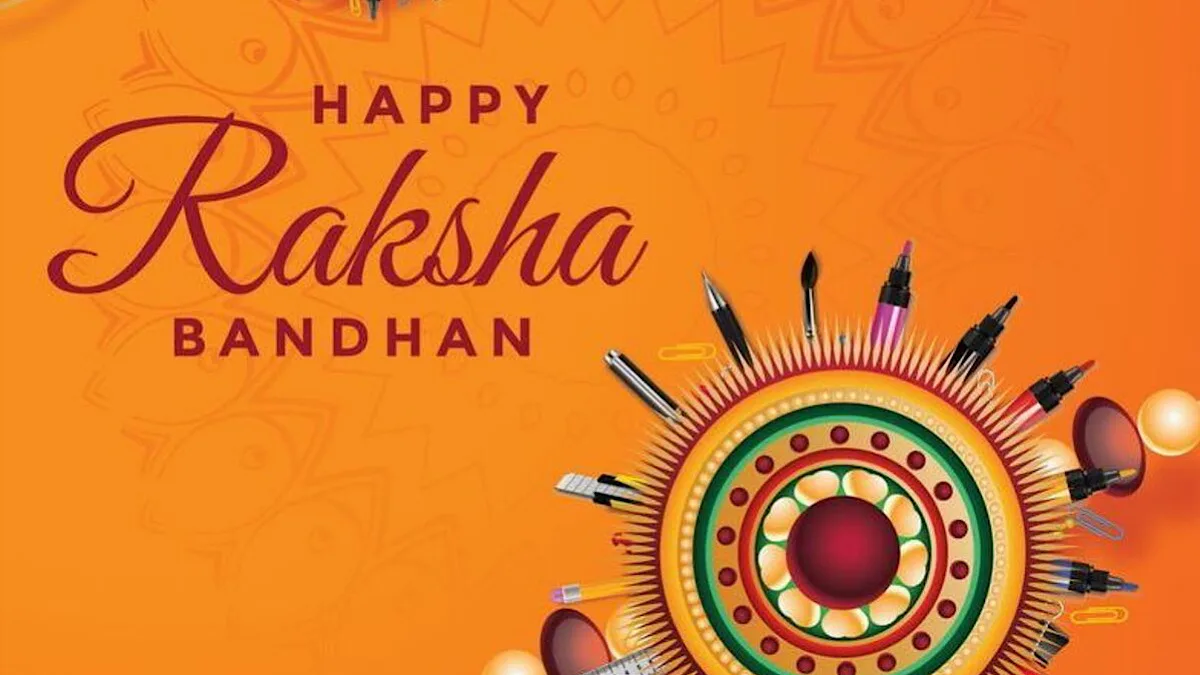
As the sun rises on August 9, a gentle golden hue will paint the skies of India, evoking a warmth that reaches deep into homes and hearts alike. Children wake up with excitement brimming in their eyes, sisters adorn delicate rakhis with tender love, and brothers prepare themselves – some shy, others confident – for the annual ritual that reaffirms a bond older than memory. Raksha Bandhan, the festival of sacred protection and affection, is not just a date on the calendar; it is a profound celebration of human connection, a reaffirmation of love and duty, and a reminder of the ties that hold us together in an increasingly fragmented world. The roots of Raksha Bandhan stretch deep into Indian mythology and history.
Ancient tales of Draupadi tearing her sari to bind Krishna’s bleeding finger and, in turn, receiving his divine protection in her darkest hour are more than stories – they are spiritual metaphors for selfless love and mutual support. Another poignant episode from history recounts how Rani Karnavati of Mewar sent a rakhi to the Mughal Emperor Humayun, seeking his protection against invaders. Responding to this call of honour, Humayun set aside his military campaign and rushed to her aid. Such legends are not merely romantic echoes of the past – they continue to lend spiritual depth to a festival that elevates the idea of duty and emotional commitment above mere ritual. In today’s India, where life races ahead in crowded cities and bustling digital networks, Raksha Bandhan has not lost its essence – it has only grown more meaningful.
Advertisement
As families are separated by geography and the demands of modern life, this festival serves as a gentle reminder of our emotional roots. Even when siblings are continents apart, a couriered rakhi, a heartfelt video call, or a fondly remembered childhood story becomes a bridge over the ocean of distance. In these moments, we rediscover the eternal value of familial love, the kind that asks for no reason and no reward. The meaning of protection, once a role traditionally assigned to brothers, has evolved. In the India of today, where women soar in every field – from science to sports, from leadership to entrepreneurship – the rakhi no longer flows in just one direction.
Sisters too promise to protect and support, not out of obligation, but from a place of inner strength and shared respect. Raksha Bandhan has become a festival of mutual care, where brothers and sisters stand by each other not because of duty alone, but because of deep friendship and trust. This evolution of the festival also reflects in the broader social fabric. Rakhi is no longer confined to biological siblings. It is tied by friends, cousins, neighbours, students, and even to those we may not know personally but whose roles in our lives we deeply value. Across the country, rakhis are tied to soldiers guarding the borders, to doctors and nurses in hospitals, to police officers, and to countless others who silently work for the safety and welfare of society.
In this gesture, Raksha Bandhan blossoms into a symbol of gratitude, unity, and national integration. It whispers the timeless message that beyond all divisions – of religion, caste, gender, or status – lies the universal human bond of love and mutual care. At a more practical level, Raksha Bandhan is also a celebration of Indian creativity and economic vibrancy. The humble rakhi, once made of simple thread, now comes in thousands of forms – handcrafted by village artisans, designed by women’s self-help groups, made from eco-friendly materials, or even embedded with seeds that can grow into plants. The festival supports countless livelihoods and small businesses, spreading joy not only in hearts but also in homes dependent on seasonal earnings.
But more than anything else, Raksha Bandhan is a deeply philosophical celebration. It reminds us that relationships are not built on grand gestures, but on small, consistent acts of care and presence. The thread tied on the wrist may be fragile, but the sentiment it represents is powerful. It symbolizes our unseen commitments – the ones we make quietly, the ones we carry in our hearts even when words fall short. In this age of fleeting interactions and digital relationships, the rakhi becomes a tangible token of permanence, of emotional reliability. India, with its millennia of spiritual heritage, has always placed great value on the unseen – the antaranga, the inner world of emotion and thought. Raksha Bandhan is an expression of that inner world, brought into ritual and form. It celebrates the silent, steady bonds that give our lives meaning and strength.
Whether it is a sister tying rakhi to a soldier she has never met, or a little boy tying one to his younger sister in a reversal of tradition, each act reinforces a value system rooted in empathy, loyalty, and the shared journey of life. As India marches forward – technologically advanced, globally connected, and economically ambitious – festivals like Raksha Bandhan ensure that our cultural soul remains illuminated. They provide moments of reflection amidst the rush, moments of togetherness amidst isolation, and moments of gratitude amidst expectation. They remind us that in the end, it is not success, speed, or achievement that gives life its sweetness, but the presence of someone who ties a thread on your wrist and says, “I’m here for you. Always.”
Thus, as rakhis are tied and gifts exchanged this August 9, let us look beyond the outer festivity and into the deeper meaning. Let Raksha Bandhan be a time not just to celebrate siblinghood, but to revive the spirit of human connection in all its forms. Let it renew our commitment to each other – not only in families, but in communities and the nation at large. For in that simple, silken thread lies the promise of a better world – one stitched together by love, understanding, and the unwavering strength of relationships that endure.
(The writer is a Thrissur-based accountant and freelance contributor.)